I, Joy Kirr, am a middle school teacher, author, and speaker. My 7th grade ELA (English Language Arts) classes are working to improve their lives through student-directed learning - without marks throughout the year. This is a log of my learning experiences... Want to have me speak with your staff or facilitate a workshop? Here is my PORTFOLIO.
Showing posts with label Mindset. Show all posts

Sunday, May 7, 2023

Mindfulness Work

Two More Books to Share...

If you know me at all, you know I'm reading for my mental health (self-help books and adult fiction and memoirs) as well as for my seventh graders (YA/MG books and nonfiction how-to books). Two books I just finished...

They helped me get through the last two weeks of April and this first week of May. My #OneWord for 2022 is "present," and Fully Present was an audiobook I received free for educators through Libro.fm. I learned through these two books to not judge myself when it comes to slipping up during mindfulness, so I forgave myself for listening to it while doing the dishes... ;) I did stop to take notes when I found a gem I wanted to keep. From this one, I was reminded of the myriad benefits of doing NOTHING for a few minutes each day. This means stopping to focus on my breathing, so I can be more in the moment, and less in the past or worrying about the future.

As for Awakened,* I re-read sections of this. I read the first 50 pages in on sitting, then thought of it during school/work the next day. When I got home, I read them again. This is not something I usually do. The next night, I read them again and then summarized them in my own words. I decided my notes for this one would be summaries first, and then I'd fill it in with specific quotes I wanted to look back on later. Because I'm so invested in making my mind healthier, I have all of my self-help / optimism / mindfulness / joy book notes printed out and put into a binder. Those I actually read again every so often when I need a boost / reminder. I love seeing repeated ideas throughout the binder. One other book that won't be in the binder that I've been reading daily is The Daily Stoic by Ryan Holiday and Stephen Hanselman. It's got a lot of the same ideas about how to be mindful, controlling your own thoughts, and not letting influences (from all over) change who you want to be. 

These two books have solidified a few things for me.
  1. It is up to ME how I feel. My thoughts control my feelings. I can take control of my thoughts.
  2. Worries, anxieties, fears ... they're all FUTURE based. When I focus on the present, they go away.
  3. When I ruminate about the past, I make those thoughts worse and more concrete, making them harder to go away. I need to remind myself that the other person involved is most likely NOT thinking of those moments now and it's only hurting me. It could even be hurting my physical health.
  4. Stop and think of each current thought. Does it do you any good? If not, let it go or replace it. Just because it's a thought, doesn't mean it's true, and it doesn't mean it's important right now. Plant the seeds of positive thoughts - you'll reap later what you sow now.
  5. It's going to take a lot of time and practice to change your thinking. All our life we're inundated by images and words that influence us. It's time for me to start taking control of what I want influencing me.
I loved being immersed in the language around mindfulness and controlling my own thoughts. Hearing it from one book, reading it in the other, then following up with a quick meditation that helped me to breathe evenly and put me to sleep each night (the Calm app) really helped some of these ideas stick.
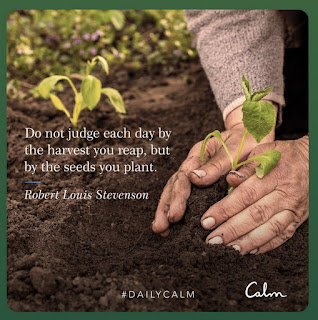
Calm App...

    This tool may still be free to educators, I hope. I'm on a streak right now of about two weeks. I've been hearing the same ideas from the two books in the app (words such as "catastrophize" and ideas such as reframing my thoughts). Just last night, after I'd taken some notes about how our thoughts are seeds, I get this one to listen to before bed:

Online Resources...

        It includes a link to their app: UCLA Mindful
        The questions / process:
  1. What negative thought are you struggling with right now? (You can choose or type an answer.)
  2. What's a recent situation that led to this negative thought?
  3. Select the thinking trap. (I really like this one - it shows possible thinking traps, such as "fortune telling," "overgeneralizing," "negative feeling or emotion," and "all-or-nothing thinking," and these change based on what you've put in for your answer. It suggests what it thinks you're doing. The AI here seems to be spot on - at least the two times I tried it.)
  4. Reframe your thinking. (First it tells you - based on what you chose as the thinking trap - a tip for how to overcome that thinking trap. Then it gives you space to type in your own reframing thoughts, and it also gives you three options it came up with. You can even click "Show more reframes" !!) Once you choose or write one, it asks you to see if you can make it more positive, realistic, or helpful. I changed one word of mine - "can" to "will" - you can see my final reframe in the photo below.)
  5. Evaluate the activity. (You do not need to do this. It's part reflection, part info for the AI, I'll bet. There is another section after that which is an optional survey.)
    1. I filled out the survey and was rewarded with a summary (which I didn't know I was going to get - this is much better than the screenshots I took)! Too bad you have to fill out the survey to get it, but maybe you can just click "next" without filling it out...

        The questions they use on this site are simple - so much so that you don't need the site:
  1. What negative thought are you struggling with?
  2. Where does this negative thought come from?
  3. If your friend was dealing with the same negative thought, what would you say to help them feel more hopeful? (I love this question!)
  4. What do you need to say or do so you can truly believe the more hopeful thought?

Conclusion

Of course, I've read many more books on optimism and joy and how to be happy during the fall and winter of the 2020-2021 school year. My post from June of 2021 about those books is here. What makes these different? The lessons are finally STICKING. I was in class the other day saying in my head, "Dismiss. Distract..." and then I focused on something else instead of that worrying/annoying/not helpful thought. Maybe they're sticking because I've read so many with the same ideas. I'll take it. And I'll probably keep reading more. What I want to do first, however, is to practice meditating for 5-10 min a day without falling asleep to it... Taking 5-10 min out of my day to let negative thoughts appear and then dismiss them can only be beneficial.

I will keep learning and practicing. With time and effort, I can learn to recognize and manage negative thoughts.

*One thing I have to add about Awakened... Page 1 starts on the left side of the book. This was at first a source of aggravation for me. By the time I finished the book, my mindset had shifted. I now wonder what other books start that way?

Saturday, April 15, 2023

Disconnected

I had this book in my Libro.fm account, and it was short, so I decided to listen to it while I did the dishes while Hubby is recovering from knee replacement surgery. We usually do the dishes together, and I wanted the distraction.

I've been having a love-hate relationship with social media and games on my phone. I spend a LOT of time on my phone. I thought this book might help me not be attached to it as much.

Here are some things I'd like to remember from this book...

She posed this question: "What part of your online life do you enjoy or do by choice (ex: curating boards for inspiration on Pinterest)?"

          I enjoy connecting with teachers on Twitter. I haven't been doing this as much as I used to, and this may be because I've set a limit for myself on Twitter, and I've done a good job of sticking to it. I'm only on Twitter in the morning for a half hour before work, and on weekend mornings. On Instagram, I enjoy seeing posts from former students and encouraging them in their college and job endeavors. TikTok makes me laugh, and when I create on it, I feel the students who follow me will benefit from the humor and book talks. I only use Snapchat when I want to play with filters and get Hubby and I laughing until our guts hurt. This happens about once a year. I don't post or follow anyone on Snapchat. I play games (daily challenge - Killer Sudoku, Blockudoku, Fishdom, Nonogram, Nonogram Color, and Elevate) to stimulate my brain. I practice Duolingo to hopefully some day be able to have an actual conversation with a student in Spanish (and later in Polish).

And she followed up with this one: "And what things do you do only because you feel you should (ex: being on Twitter for professional purposes)?"

          I do feel like I need to post a bit every day on Twitter. That's where I (used to) market my book(s), share the good about GeniusHour, share that and my Antiracist LiveBinder, amplify other people's great ideas, and I feel like my followers expect me to be real and to share what I believe is important. I've been quieter on it lately because, like Mom said, "If you can't say anything nice, don't say anything at all," and since teaching in a pandemic, it's been harder for me to find positive and valuable things in education to share.

"We get to say no. We get to change our habits."

          This quote/idea has helped me stop playing so many games on my phone. My favorites for zoning out: Nonogram, and Nonogram Color. I have time limits on these, and at 8:00, all tech is off my phone (except books and Duolingo). Knowing that when I zone out on them I often think of problems at school, I now recognize these thoughts earlier, and I click the "ignore" button a bit quicker.

...insert app name here.

Every time I put my earbud in my ear to listen to this book, I hear, "Connected," which means my phone is connected to the earbud. To me, it meant "Joy can't just do one thing - she's got to listen to a book while she does the dishes, even." That fact bothered me, but I didn't do anything about it, because I thought it was a good use of my time... Another thing that happened was that while I was "reading" (and doing the dishes), texts from a friend came through. I tried to not look at them until I was done doing the dishes at least... 

The author likes Seth Godin, and she quoted him many times throughout.

It's good to amplify others' great ideas - while giving credit, of course. 

It's good to connect with others in smaller communities. It's even better if we try doing this OFFline.

Everyone - and everything - is an influence(r).

"I want my online life to influence my offline life for the better."

---------------------

Yes. Yes. Yes. I want my online life to influence my offline life for the better. So much of what I see on Twitter affects me in a negative way lately. The news, what's "trending" (I STILL haven't quite learned to NOT click on those items!), the replies to tweets (anonymity brings out the worst in people, I've decided), and those teachers who aren't teaching anymore telling me what I "should" and "should not" do (consider suggesting things, eh?). I find myself feeling upset and thinking judging thoughts, and I don't like that part of me. I need to find a way to use Twitter to my advantage again. This has me unfollowing those that don't affect me in a positive way, and taking some people off of my Twitter lists that I use on Tweetdeck. I'm making what I see more positive and a more hopeful start to my mornings. I have that control, and that feels like a positive step.

Since being reminded that everyone and everything is an influence on people, I've tried to look at things differently. In the grocery store, when I want to buy something I see (if it's not on the list), I consider what it's actually called - an "impulse buy." I've found myself shaking my head and passing by. When I'm in line and see more things I want to buy, I consider why they put those items there. I don't want to be controlled in this manner, so that little bit has helped me make smart decisions - at least in a store. It's also helped me to keep smiling and listening at work/school. Doing so may influence others to smile and to listen - or at least to feel better around me smiling at and/or listening to them. It's even helped me drive better - especially when someone around me isn't driving their best. I don't let them influence me to drive like a maniac or get in their space.

Knowing that I was choosing this book to hopefully influence me in a positive way, I did one of the things the author suggested. I tried doing nothing - for five to ten to fifteen minutes. Although I got better at it when school was shut down, this is still difficult for me and takes a lot of practice. She asked, "What did you realize about yourself?" I sat in my backyard on a bench, and after just about five minutes, I realized... I like to help things grow. I can totally use this information in my job, in my online space, and at home. I decided to try again -what's five minutes, right? This time around, I realized that I learn WAY more from my mistakes at 50 years old than I did when I was a teen or pre-teen. It got me thinking... can some of our students not be able to learn from their mistakes yet? Even writing about this, I feel the urge to do nothing again - tonight.

A little irony... I broke my own Twitter time boundary and tweeted these two realizations (under the tweet that I was reading this book). I shared them online because I thought they might influence another person to try this on their own. I'm also writing this post for me (I keep my book reviews like this on my blog) and sharing it via Twitter. If it can help one person try one thing that positively influences their life, I think it's worth it, and it aligns with why I got on Twitter in the first place.

After I read any self-help book of any sort, I try to put one thing into practice. I used to try to put them ALL into practice, but I've realized it doesn't work for me. My one thing from this book will be to try to do nothing for at least five minutes each day - when I feel the pull of my phone. This aligns well with the lessons I (thought I) learned during pandemic teaching. It also aligns with my #OneWord I've chosen a couple of years in a row now - PRESENT.

Although this wasn't my favorite book (3/5 stars), it was free, it helped me get the dishes done, and I took away some good reminders.

Sunday, January 12, 2020

Conference Musings - Shift in Focus in Year Five

I work in a school system that requires grades at the end of each term. Although I do not have points or marks during the term, I am required to come up with one often-arbitrary letter that is supposed to represent student achievement in our ELA (English Language Arts - reading, writing, speaking) class before report cards are issued. This year, the elementary schools in our district are in their second year of standards-based grading, and I'm hopeful we'll have it at the middle school level by the time I retire. Until then, I believe the way I'm trying to help my students learn without the reward, threat, stress, or constant checking of their grades is the route I need to take.

Since I piloted "Feedback in Lieu of Grades" in 2015-2016 with one class and then used it each following year, my favorite part of the year is conferring with students each quarter. (Sadly, it's also the time of the year when I get a migraine due to the stress of "getting it right" and "not making parents mad or students cry." This quarter, I blamed the migraine on the barometric pressure, but my friend and hubby may be right, as they saw the correlation before I did.) Conferring is my favorite part, as I can look through the evidence with each student individually, and they can voice their opinions on what they believe they should get on the report card based on that evidence. They reflect on the goal they made last quarter, and they either create a new goal for the next quarter, or keep or tweak the one they had. I am able to write about their achievements and habits, along with their contributions, as we sit alongside each other. I love to see the smiles on their faces when they read what I've written, even if the grade they are getting isn't that often-sought-after "A."

This quarter, one of my students lost a parent. Another has a parent in hospice. Others are dealing with hurt I can't comprehend. My focus as we started conferring this past week was compassion and celebration. I've been the calmest I've been during these conversations. I, myself, have carried less angst into these conversations, as I'm truly NOT focused on the grades. I'm practicing what I preach, focusing on what they've learned, and the habits or mindsets that have gotten them to where they are at this point in the school year.

Maybe it's because my own mindset is better this year. Or maybe it's because parents haven't complained about how they have to take more time if they want to know how their child is doing in our class (they have to go into each assignment and click "view" to see the comprehensive narrative feedback). Or maybe it's because I had one parent tell me that she actually gets MORE information from our class than from the others. No matter the reason, I'm glad my focus has shifted again. I'm glad I have enough confidence in the system I've created in my tiny corner of the school to be able to simply reflect on how the quarter has gone with each student. In this fashion, we can make a plan for next quarter and start working towards it.
Made with Pixabay + Keynote
Last quarter, due to this type of grading being a bit too stressful for the grade-driven seventh graders, I switched two students over to more "typical" grading. This quarter, at least one other student is going that route. The other students aren't even aware of this, as we're still doing the same activities, and we're still speaking the same language of doing this work in order to learn... not in order to get a good grade.
I still don't have it all figured out. I still have four days of conferences this week with students and one or more may cry. I may still get an angry email from a parent. At this point, however, I am glad the students and I have the relationship we have in order to reflect honestly on how the second quarter of the year has gone and to make plans as to where we go from here.

Want more stories? Check out the reflections I've shared on other times I've conferred with students. Looking to have conversations like this with your students? --> Pages three & four of this document show what we discussed at our conference this past quarter (third and fourth quarters will be added when I need them).

More resources: 
     Frequently Asked Questions for Parents on our classroom Weebly
     Feedback Instead of Grades LiveBinder for parents (and teachers) to peruse
     My own reflections on this journey

Monday, June 29, 2015

The Marble Theory

I finished Paul Solarz's Learn Like a Pirate: Empower your students to collaborate, lead and succeed over a month ago, I believe. It's time to blog about one idea on pages 63-64 that I MUST implement next year within the first week... The Marble Theory.

We've all got these students...
     ...those who do well in our class...
          ...and those who don't do so well in our class.

And the students notice, too. Some egos become more inflated, and others more deflated as the year goes on. I hope, that the more time I spend on Genius Hour-type activities, the more students see that ALL students are skilled, and in many different ways. How do I share this idea with something tangible? How can I embed this idea in the minds of 12-13 year olds? Paul shares this great idea...
"Some students come into my classroom with very low self-esteem, due to low grades or poor performance in school. Others believe they are better than their peers because of past success in school. My goal with Marble Theory is to level the playing field. I want my students to realize that we are all equals with amazing gifts, talents, and interests. No one is better than anyone else. No one is worse. Once they understand we are all equals, increased respect leads to improved collaboration.
The Marble Theory states that we are all born with the same number of marbles in our brains. When we are born, these marbles are just in a big pile, but over time we allocate these marbles into cups. The cups represent our skills, talents, and abilities. We can have as many cups as we need and these cups are extremely specialized. For example, we don't have a cup for reading abilities. Instead, we have several cups for reading: one dedicated to decoding, one for literal comprehension, one for inferential comprehension, one for oral reading fluency, etc. But we also have cups dedicated to dribbling a basketball, drawing horses, telling jokes, and playing the flute.
In school, teachers usually spend time evaluating how many marbles students have in their academic cups, causing children to falsely assume that grades determine how intelligent they are. Kids who have many marbles in their cups dedicated to math, reading, writing, spelling, science, and social studies become known as the "smart kids." Children who have fewer marbles in those cups but more in their musical, athletic, interpersonal, or creative cups are not given the same accolades.
Quote used w/permission
I contend that we are all equal in terms of intelligence and that intelligence needs to be measured differently. Because of grades and report cards, students learn to think of themselves as smart or dumb. Low grades do little more than disappoint and discourage students. High grades often create perfectionists and cause children to become extrinsically motivated. ... "
I would love for students to recognize just where their talents lie. In what "cups" do they believe they have the most and the fewest skills? I will ask students to figure this out in some way. My dream would be to try this with actual Dixie cups and marbles. I don't believe I can afford as many as I'd like, and I'm not really THAT ambitious, so I'll resort to a blank sheet of paper, circle templates (lids off milk cartons) and hole punches - 100 "holes" for each of my 70 students. (I wonder - is there a spray glue students can use to just stick it all on when they're done placing them? Or... should this one be an activity they work on at home??) If the holes don't get punched (a lunch bunch project??), we can resort to dots using markers. These charts can be the start of our "Resident Expert Wall of Fame," where we recognize each other's talents/skills/genius. Heck, this activity can even be part of Dot Day around September 15th!

Update: A high school teacher shares her day with The Marble Theory in this post.