I, Joy Kirr, am a middle school teacher, author, and speaker. My 7th grade ELA (English Language Arts) classes are working to improve their lives through student-directed learning - without marks throughout the year. This is a log of my learning experiences... Want to have me speak with your staff or facilitate a workshop? Here is my PORTFOLIO.
Showing posts with label books. Show all posts

Sunday, May 7, 2023

Mindfulness Work

Two More Books to Share...

If you know me at all, you know I'm reading for my mental health (self-help books and adult fiction and memoirs) as well as for my seventh graders (YA/MG books and nonfiction how-to books). Two books I just finished...

They helped me get through the last two weeks of April and this first week of May. My #OneWord for 2022 is "present," and Fully Present was an audiobook I received free for educators through Libro.fm. I learned through these two books to not judge myself when it comes to slipping up during mindfulness, so I forgave myself for listening to it while doing the dishes... ;) I did stop to take notes when I found a gem I wanted to keep. From this one, I was reminded of the myriad benefits of doing NOTHING for a few minutes each day. This means stopping to focus on my breathing, so I can be more in the moment, and less in the past or worrying about the future.

As for Awakened,* I re-read sections of this. I read the first 50 pages in on sitting, then thought of it during school/work the next day. When I got home, I read them again. This is not something I usually do. The next night, I read them again and then summarized them in my own words. I decided my notes for this one would be summaries first, and then I'd fill it in with specific quotes I wanted to look back on later. Because I'm so invested in making my mind healthier, I have all of my self-help / optimism / mindfulness / joy book notes printed out and put into a binder. Those I actually read again every so often when I need a boost / reminder. I love seeing repeated ideas throughout the binder. One other book that won't be in the binder that I've been reading daily is The Daily Stoic by Ryan Holiday and Stephen Hanselman. It's got a lot of the same ideas about how to be mindful, controlling your own thoughts, and not letting influences (from all over) change who you want to be. 

These two books have solidified a few things for me.
  1. It is up to ME how I feel. My thoughts control my feelings. I can take control of my thoughts.
  2. Worries, anxieties, fears ... they're all FUTURE based. When I focus on the present, they go away.
  3. When I ruminate about the past, I make those thoughts worse and more concrete, making them harder to go away. I need to remind myself that the other person involved is most likely NOT thinking of those moments now and it's only hurting me. It could even be hurting my physical health.
  4. Stop and think of each current thought. Does it do you any good? If not, let it go or replace it. Just because it's a thought, doesn't mean it's true, and it doesn't mean it's important right now. Plant the seeds of positive thoughts - you'll reap later what you sow now.
  5. It's going to take a lot of time and practice to change your thinking. All our life we're inundated by images and words that influence us. It's time for me to start taking control of what I want influencing me.
I loved being immersed in the language around mindfulness and controlling my own thoughts. Hearing it from one book, reading it in the other, then following up with a quick meditation that helped me to breathe evenly and put me to sleep each night (the Calm app) really helped some of these ideas stick.
Calm App...

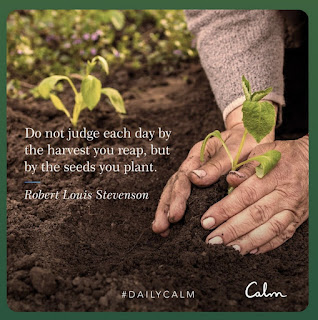
    This tool may still be free to educators, I hope. I'm on a streak right now of about two weeks. I've been hearing the same ideas from the two books in the app (words such as "catastrophize" and ideas such as reframing my thoughts). Just last night, after I'd taken some notes about how our thoughts are seeds, I get this one to listen to before bed:

Online Resources...

        It includes a link to their app: UCLA Mindful
        The questions / process:
  1. What negative thought are you struggling with right now? (You can choose or type an answer.)
  2. What's a recent situation that led to this negative thought?
  3. Select the thinking trap. (I really like this one - it shows possible thinking traps, such as "fortune telling," "overgeneralizing," "negative feeling or emotion," and "all-or-nothing thinking," and these change based on what you've put in for your answer. It suggests what it thinks you're doing. The AI here seems to be spot on - at least the two times I tried it.)
  4. Reframe your thinking. (First it tells you - based on what you chose as the thinking trap - a tip for how to overcome that thinking trap. Then it gives you space to type in your own reframing thoughts, and it also gives you three options it came up with. You can even click "Show more reframes" !!) Once you choose or write one, it asks you to see if you can make it more positive, realistic, or helpful. I changed one word of mine - "can" to "will" - you can see my final reframe in the photo below.)
  5. Evaluate the activity. (You do not need to do this. It's part reflection, part info for the AI, I'll bet. There is another section after that which is an optional survey.)
    1. I filled out the survey and was rewarded with a summary (which I didn't know I was going to get - this is much better than the screenshots I took)! Too bad you have to fill out the survey to get it, but maybe you can just click "next" without filling it out...

        The questions they use on this site are simple - so much so that you don't need the site:
  1. What negative thought are you struggling with?
  2. Where does this negative thought come from?
  3. If your friend was dealing with the same negative thought, what would you say to help them feel more hopeful? (I love this question!)
  4. What do you need to say or do so you can truly believe the more hopeful thought?

Conclusion

Of course, I've read many more books on optimism and joy and how to be happy during the fall and winter of the 2020-2021 school year. My post from June of 2021 about those books is here. What makes these different? The lessons are finally STICKING. I was in class the other day saying in my head, "Dismiss. Distract..." and then I focused on something else instead of that worrying/annoying/not helpful thought. Maybe they're sticking because I've read so many with the same ideas. I'll take it. And I'll probably keep reading more. What I want to do first, however, is to practice meditating for 5-10 min a day without falling asleep to it... Taking 5-10 min out of my day to let negative thoughts appear and then dismiss them can only be beneficial.

I will keep learning and practicing. With time and effort, I can learn to recognize and manage negative thoughts.

*One thing I have to add about Awakened... Page 1 starts on the left side of the book. This was at first a source of aggravation for me. By the time I finished the book, my mindset had shifted. I now wonder what other books start that way?

Friday, June 25, 2021

Mental Health Lessons Learned from Books Read During Pandemic Teaching

 ...and in order to keep coming back to them, I'm writing them into one post.

These first three books I read prior to the pandemic. The lessons I remembered from them helped me during the pandemic.

Fewer Things, Better - 1) Check email only at one or two certain times per day. (This did NOT work during remote and hybrid teaching!) This goes for a TON of apps and websites, actually - it helps me be more present in each moment. 2) What do I want my legacy to be? Do that. 3) Who says you have to (insert job here - ex: send home weekly updates to parents)? Many of the rules I follow are my OWN. I probably don't even need to (insert job here - ex: this past school year I sent monthly updates to parents). What pressures have I put on myself that I can make easier for myself? My original reflection is HERE

The Zen Teacher - 1) Do one thing for myself every day. 2) Be present in the moments - the still and chaotic moments. 3) Declutter a part of your life - get rid of what you don't need and/or what you're not using. My original reflection is HERE

Teaching Well - 1) When we are the most overwhelmed with work is when we NEED to stop and take care of ourselves - put away the work, get some exercise, water and sleep, and experience a bit of your life outside the classroom walls. Psychologist Simone McCreary - "There is plenty of evidence that we do better in our career when we make self-care a priority... Regular physical activity activates our neuroplasticity, which increases our creativity and focus. Exercise rejuvenates our willpower" (16). 2) David Irvine - "Self-care is a responsibility. If we don't take care of ourselves, we eventually won't be able to carry the responsibility of caring for others" (18). There will always be work - the work for teachers does not end. My original reflection is HERE.   Another reflection on these first three books is HERE.


The next few books are in order of when I read them.

The Other Half of Happy by Barcarcel - "...we are all unfinished. And unfinished is fine."

Hearts Unbroken by Smith - "Every breath is a victory."

How to Disappear Completely by Standish - "...the battles we fight always change us. When we are fighting them, all we can see is how they wound us. But they can change us for the better, too."

Essentialism - The word "priority" was intended to be singular. What's my ONE priority? My health - mental and physical. Everything I decide to do (or not do) should be good for my health. My original reflection is HERE. 

The Canyon's Edge by Bowling- "Being alive means / sorrow, joy, pain, love, anger. / Feeling all the things."

Learned Optimism - 1) Being pessimistic can make me physically sick, as it actually lowers my immunity. Therefore, it's unhealthy to use my time ruminating on bad moments or situations. Know that what I'm going through (bad OR good) is temporary. 2) Have hope, and make practicing gratitude a habit. My original reflection is HERE. 

Strange the Dreamer by Taylor - "And that's how you go on. You lay laughter over the dark parts. The more dark parts, the more you have to laugh. With defiance, with abandon, with hysteria, any way you can."

Untamed by Doyle - I've felt this way before, and I'll feel this way again. Notice the feelings, feel them, and then consider, "What do I do next?" Act on it.

The Book of Joy - 1) I can only do so much. Although I can't change the world today, I can make a difference with one, two, or even more students EACH day. 2) Practice gratitude and compassion - I'm excited to find ways for my students to practice compassion, as well. My original reflection is HERE.

Efrén Divided by Cisneros - "Somehow, you just do what needs to be done... whether it's fair to you or not."


Tuesday, June 9, 2020

Day 88 - Triangle Perspective

Day 88 - June 9 2020

In February of this year, I read The Courage to Be Happy... by Ichiro Kishimi & Fumitake Koga. I read it because my library did not have The Courage to Be Disliked, which a Twitter teacher friend had recommended. I figured I could learn something anyway. It turns out that this one was the sequel to the first book, and it was explained enough in the beginning for me to catch on pretty easily.

I took a few notes while driving (I listened to this one on CDs from my library), and one note in particular stands out to me today.

The philosopher talked about a triangle. On each side of the triangle, there were phrases that represented people's perspectives when they came to him...

He realized this and decided to ask those who came to visit -
     Which one would YOU rather talk about?

Since yesterday was my first "official" last day and summer can start today, I'm focusing on what I can DO from here. If you're a faithful reader, you won't see as many posts here, you MAY see more posts here, you'll see less of me on Twitter (I've found it challenging to talk about race with fellow White educators), you MAY see more of me on Instagram (my students reside there), you'll find me reading more fiction for rest and more nonfiction for action, and I'll be taking care of myself more. All of these shifts in what I'm going to do this summer may actually help me DO more for others.

Saturday, August 3, 2019

Word Shift!

Here's the inside story...

If you read this post, you may feel a tad bit uncomfortable.
The same goes for when you read Word Shift...
http://shiftthis.weebly.com/

Shift This had been out for a few months, and readers had been connecting with me about the resistance they had felt, and how, after reading the last chapter (on resistance!), they felt less alone. They felt less "crazy." We are not alone. There are a TON of educators who want to shift what's happening in their classrooms.

And we are not crazy - we are readers, researchers, writers, contributors, explorers, collaborators, hypothesizers, experimenters, adventurers, risk takers, learners, visionaries, coaches, guides, amplifiers, leaders, and change makers! We are trying to do what we believe is right and good for the young learners in front of us every day.
I shared this message in my first keynote session in Boston last year, after I'd written that part of the book. (I'm sharing it again at IETC in November.) I then dug into the tough stuff... how educators speak at school when there are no children around, and how this affects our students.

One student who had issues at home was an angry child. He was angry with his parents for their divorce, I'd heard he was not a fan of his step-dad, and I'm not sure he was getting the attention he desired at home, as much of it was being directed to his younger sister for various reasons. This is how I saw him in our class. I saw him as someone needing my attention and caring. He wasn't the best behaved, for sure, and it was pretty rough on me. So... I did what I could. I learned about him slowly over the first few months. We developed a pretty good relationship, as we figured out a plan that worked for him, and we even shared a couple of jokes (the ones that didn't distract the class too much). He knew how to make me sing, even - he would hum the first five notes of "Try Everything" by Shakira, and I was hooked!

Then my mind was spun in circles one day. Frustrations can run high in school settings, and educators (I'm no exception) don't always say the perfect words. One coworker of mine, while talking amongst other teachers, called this child an a-----. I tried to help steer my own thoughts by saying even though he may ACT like an a-----, he's still a child. That day, the next day, and the day after that, my brain was tainted with this label for this child. NO. Nonononono. I did NOT want to think of this child as an a-----, and yet the seed had been planted. I worked my butt off the rest of that year trying to get that word out of my head. Trying to get this LABEL out of my head.

We use so many labels. It makes my stomach turn. I started writing down all the labels I've heard used and have used myself. I then began to listen better and hear more words I've used that may be better left unsaid.

What pushed me over the edge was the last day of the 2017-2018 school year. My coworker Yvette and I asked students for further feedback. The question that day was, "What did we do well, and where can we improve for next year?" One sweet seventh grader said, "Thank you for not saying you're going to chop off my knee caps," and another piped in with "...or light us on fire!"

Nonononono. Some twelve year olds do not do well with sarcasm. These words were the ones that encouraged me to write with the full intent to ask the DBCI group to help me publish it. The ideas in this book came from many educators' words from around the world, not solely from my experiences at my current school, obviously.

I've said some harsh things to students - and teachers - in my past. For sure I won't be perfect moving forward. (Oh, goodness, how I have to learn how to listen more than I speak!!) I want to be better. I want to communicate precisely what I mean, without attaching any negative labels to students or peers. There are also all those words we leave unsaid, that really need to be said - to students and to peers. Consider when we close our mouths in class, and yet we could use that instance to teach about grief, mental health, racial inequalities, or any of the myriad other relevant topics that our students know more and more about due to their access to information.

Writing this book has helped me consider words we use in a new light. As we read Word Shift (yes, I'll be reading bits and pieces again), I hope we evaluate words we, our peers, and our students use, and share others that work more effectively and can be used more often in our schools. How will we find our voice and use it when we hear negative language in schools? How will we elevate and amplify positive messages so they reach more students and colleagues?

Tuesday, July 9, 2019

#WeNeedDiverseBooks

#WeNeedDiverseBooks is a movement that's been going on since 2014.

I've always thought of this from a children's book point of view, and I started looking through my myriad classroom books. I tossed some, gave away some, bought some, and since I've noticed that I do need more diverse books, I've been READING a ton more - so I can share them with my students.

Then my viewpoint shifted this past week when I engaged in a direct message conversation with a teacher I respect about how many of the educator books out there are written by white authors.

This tweet from a different educator I respect - Mike Mohammad - struck a chord with me...

Although I have written one of those, and read six of them, I noticed that a couple of these above are not written by white authors, and that is a good sign. I do believe, however, when we look at the newest educational books that are being published recently, most are written by white men, with white women starting to chime in, as well. Are BIPOC (Black people, Indigenous people and People of Color) not represented enough? (Are they not represented enough in our schools, as well?) I believe they are not. I believe we need more. Since I have not yet read all of them, I don't know if this is true, but are most of these rooted in what we (as authors of these books) know from experience? I know that Jennifer Casa Todd's had references to research, but do any of the others? Mine has links and names of people where I've learned certain things, yet I'm not sure if any of them (except in the homework and grading chapters) are researchers. So I responded to his tweet in a different way...


Are you the next author of a book that will inspire educators to have the courage to address racial inequalities in our lives? Are you the next person future teachers will look up to because you wrote of what needs to be said and done in this newest time of turmoil? Are you the next one to publish a book with research to back it? If not you, who do you think it could be? Please share this post with them.

The author of the blog challenge I'm in asks this question this week - 
I write lots of posts and keep them in "drafts." When I'm finally ready to share my feelings or thoughts, I go back to the post and click "publish." This post was in my drafts for a bit, then I saw the question today for the #8weeksofsummer blogging challenge. Yes. It's not only my goal for this summer, but it has been for a year now, since reading Being the Change by Sara K. Ahmed. 
  • Read more books by authors who are not white. 
  • Share more writing in class by authors who are not white. 
  • Talk about it in class - the races of the authors we read - so students know that they're out there, and we need more of them in our classrooms. 
  • Let our students know that THEY can be the ones to write the next book or poem or narrative - and publish it so others hear their stories.

Some (white) people will overlook this post and not share it with the world. I used to understand that; I kind of still do. I am learning that my silence means I'm okay with it. I'm not okay with ALL voices not being heard equally. I try to make sure this happens in my classroom, and I am now trying to make sure this happens in my life outside the classroom. My BHAG? For summer? Nope. For life? Yes. 
Spread kindness. Stand up for equality. Get kids reading. Get kids thinking. 
They're all linked together.

Note: This post does NOT mean that if you ARE white, you should not write. Nonononono. In fact, if you are a teacher and teach writing, you should be writing. We can all be awesome role models for our students through reading and writing - ALL KINDS of books and articles and blog posts. I'm sorry if this post reads otherwise. That was not my intent.

Wednesday, June 12, 2019

Summer Reading - My Plans

I always want to read MORE. As much as I read over the summer, it's never ENOUGH.

This summer, I have a plan. (I don't usually!)

I'm going to read from two lists, for sure:

     Our SD25 Middle School Summer Reading list - "Reach for the Stars"
          (Kind of not fair, as I've read eight of the twelve already...)

     #ProjectLITBookClub 2019-2020 selections (Follow them on Twitter here!)


When I want something different, I'm either going to choose a book that is on a list of some sort, or an award-winning book - by authors who are not white. Yup. It's time for more diversity. It's time I truly focused on it this time, instead of just being "lucky" coming across a book by an author of color. That being said, I just received a book in the mail from a fellow white educator... I'll be reading that one, as well.

For my students, I shared with them (once again) this page on our classroom Weebly - it's got lots of ideas for summer reading!

Do you have a favorite resource for good books? What are your summer reading plans? Thanks for sharing and reading!

This post was a few weeks in the making. The inspiration to post it comes from this challenge:
This post is week 1 of 8 in the 8 Weeks of Summer Blog Challenge for educators.

Post-Summer Update...
I have now read the following books (some I read years ago) from the #ProjectLitBookClub lists (going across in order):
     A Long Walk to Water
     Amina's Voice
     The Bridge Home
     A Good Kind of Trouble
     Blended
     Other Words for Home
     Merci Suarez Changes Gears
     Crossover
     First Rule of Punk
     Front Desk
     The Parker Inheritance
     The Last Last Day of Summer (abandoned)
     Amal Unbound
     The Benefits of Being an Octopus
     Ghost Boys
     Time Bomb
     Refugee
     New Kid
     Full Cicada Moon
     Look Both Ways
     Ghost (the entire series)
     The Wild Robot
     The Stars Beneath Our Feet
     Wishtree
     Wonder
     El Deafo
     A Very Large Expanse of Sea
     Hey, Kiddo
     Internment
     Monster
     Scythe
     The Marrow Thieves (abandoned)
     The Prince and the Dressmaker

Tuesday, January 22, 2019

Speed Dating - with BOOKS!

The first time my classes tried speed dating with books was in 2013. It's time for a new blog post!

Before we first started, I found these blog posts to be especially helpful:
Tips for Getting Kids to Do More Choice Reading: Book Speed Dating
          by Erica Beaton (@EricaLeeBeaton)
Building Our To-Read Lists: Book Speed Dating
          by Colby Sharp (@colbysharp)
Book Speed Dating: How I did it and why I'll do it again
         by Leigh Collazo (@MrsReaderPants)

We've usually got some kind of contest or challenge going on for reading at our school library. This month is no different. With the challenge in mind (and the new face lift our library has had), here's how it was set up (and now our teacher-librarians set it up for us!):

There were six tables, with different categories from our "TMS Tower" challenge. Here are the challenges:

We're hoping students will find this fun, fairly easy, and will get them out of any "reading ruts" they may be in currently.

The challenge was explained, students received a page where they can take notes on which books might look appealing (and from which category they come), and we broke into small groups (3-5 depending on the class size) and let students browse for about 3 minutes per table. Then students regrouped and the local library challenge (100 Books before High School) and prizes were announced.

I loved the twist this time with these fun categories. I also loved the incentive to complete the challenge by the end of the year - when you complete it, you get to choose a book to donate to a library in need. Mrs. Fahnoe shared how fortunate we are at our school to have such wonderful books (most in great condition!), and how it'll will be beautiful to see more books going to kids who need them.


Of course, not every child took this seriously. That doesn't mean we're giving up! The plethora of books should be a clue to them that there IS a book for them out there, should they choose to stop and take some time with it...

Saturday, September 8, 2018

Another Shift to Curriculum Night

I don't remember when we started calling it "Curriculum Night" vs. "Parent Night" or "Open House," but I'd like to share what I tweaked this year, and how it went. (Previous posts about parent night are here from 2017, and here from 2013.)

I kept the same question of the day (night?) for parents to answer with their child's magnet - they seem to like finding the magnet and moving it, then discussions continue as they sit down while I'm greeting more arrivals. (How much did YOU enjoy 7th grade?)

One thing I felt I NEEDED to do was to cover the white board tables. I went for - and received! - grant money four (?) years ago for IdeaPaint for my classroom tables. We'd painted 12 of the 15, as some students didn't want it. Since then, they've been scrubbed with some super-amazing cleaner that has now washed off the protective layer they used to have. So... those goofy drawings of odd faces? Yup. They now look pretty permanent. The questions about the text we're reading? Yup. Still there. It doesn't seem to bother the seventh graders, but it bothers me. Hubby went to the dollar store and bought me six white table cloths, and we folded them twice to place on six of the nine whiteboard tables that are left (I swapped out three of them for two smaller - and square - tables last year - students decided which tables needed to go). If I don't get the gumption to purchase this whiteboard contact paper a colleague recently used to cover his tables, I'll go with the table cloths again next year, too!

Then I collected many books from home. I wanted parents to understand that I keep up with professional development. I also thought - what if THEY read what I've read? They may understand my teaching a bit more, and perhaps share with other parents. So.... I created check out slips for the books I thought parents might enjoy reading. (Here they are - make your own!)

Some books I kept at home, thinking they would be more beneficial to teachers than parents, but I did bring over twenty, so the box was heavy enough as it was. ;)

Was my plan successful? Three points that make me think it was... I was able to share that The Power of Reading really simply stated, "The only way to understand reading more is to READ MORE." One parent (who also teaches ELA) said I had some "awesome books" there, and another parent CHECKED ONE OUT!! Yes! The Feedback Fix by Joe Hirsch was the winner of the night.

Side note: My husband and my co-teacher were the ones who said I should bring Shift This. I just couldn't! Plus, it was not a text that had influenced my own teaching. It was a result.

The rest of Open House / Parent Night / Curriculum Night went very well. I let parents know I was available after the night was over for further questions, and no one showed. (I figure the ones that need to ask weren't able to show this night.)


The next day, one student shared with me that his dad said we had a "touchy-feely" class. He said this right after I had touched his shoulder to say hello when he walked in to class. So I sprang back and said, "Oh, I'm sorry - I just do that automatically!"
He replied, "No. He means it's a comfortable class." I'll take it!

Wednesday, December 27, 2017

Lessons from Ms. Bixby

Have you read it yet?


If not, head to the library right now - oh, forget it. Get it at the book store - you'll want it for your classroom!!

A huge thank you to Michelle Gledhill, who shared pages 25-26 with our seventh graders, where Brand details the time he picked his friend's nose... That was the hook that got me to read this one.

The same author as Posted, which I read this summer (and had to purchase for room 239 readers, as well), Ms. Bixby's Last Day is a story you want to last and last. It's got everything. From Iron Maiden to Tchaikovsky, from "The Princess Bride" to To Kill a Mockingbird, and of course, the Beatles, April Fool's pranks, "The Charge of the Light Brigade," "Star Wars," legos, and The Hobbit. On page five, Topher begins to explain the six kinds of teachers in the world, and he's spot on. You know them, and you probably are one of them: Zombies, Caff-Adds (or Zuzzers), Dungeon Masters, Spielbergs, Noobs, and the Good Ones.

Ms. Bixby, of course, was one of the Good Ones. Which is why I was surprised when I came to the conversation about grades she had with a parent who was upset with his child's "B" grade. (Pgs 86-89) Steve's dad has a meeting with Ms. Bixby... (If you can't read it, try clicking on the photo to make it bigger. Or, better yet, go grab the book.)


Lessons (Re-)Learned...
  • Parents and teachers want children to learn.
  • Parents and teachers care about their children.
  • Parents and teachers sometimes think differently about what a grade means.
  • I wish parents and teachers could stop talking about grades, and only talk about learning and progress.
  • I feel like I'm in good company with Ms. Bixby.

Pick up this book.
Give it a read.
Give it to someone else to read.
Read it aloud to your class.
You won't regret it.

Wednesday, May 10, 2017

Shift This!

Here's the inside story...

A large publisher of educational books contacted me in 2015, asking me to write an outline for them for a book about Genius Hour. Hmmm... That had been done - a few times by then, and even more by now. The list is growing, and I keep it on the LiveBinder here.

So I wrote an outline about what trying Genius Hour did for my classroom... and they said that wasn't what they were looking for. I was told I could write a blog post for their website. Harumph.

I had shared the first part of the story with my students, so I had to update them on this disappointment. They threw my words back at me... "If it's something you want to do, you should do it anyway." They had a point. So I kept going. Why not?! [Fancy this - Bob (Hubby/soul mate) - had told me earlier... "It's only a matter of time."]

In August of 2016, I had a revelation of sorts, and I was almost finished with this book about shifts I'd made since implementing Genius Hour. It felt like a huge blog post about how I've changed so many parts of our classroom as a result of handing over one hour a week to my students. I thought of Dave & Shelley Burgess... And I thought, "The worst they can say is 'No.'"

And now it's here. After months of going through the editing process (such great lessons for me that I was able to share with my students!!), and multiple nights wondering, "Is it good enough?"... it has arrived on Amazon.

Here is a glimpse inside the book - through the lens of the website.
If you're reading the book, please connect with me through a blog post or your thoughts in an email. I'd love to add your ideas to the website, so others can learn from YOU! Let's keep the conversation going so we can shift learning back to our students!

Addition 5/13/17: Here's Dave Burgess's rendition of why you should read Shift This!

Sunday, March 15, 2015

The Phantom Tollbooth - Quotes

I've had it on my list for years... then good ol' fate stepped in!

I checked out three books from my local library, and two were semi-random. One of these was The Phantom Tollbooth by Norton Juster. It's been on my list, and I remember Paul Solarz saying he loved reading it with his kids. It was also on our "BOB" (Battle of the Books) list for our local library, so I grabbed it... not really wanting to read it, but feeling like I should.

As fate would have it, I was able to visit Paul's classroom this past Friday after a doctor's appointment! (Yes, he's local - in my district! How is it that I only see him at EdCamps?!?!) I could write all about all I noticed in his classroom, but that's for another post. Of course, I had to look at his fabulous library along one wall of his room, but then he showed me all the other books he had stashed away... Literature circle books for the year, and whole-class read alouds (and "read alongs," because he had enough copies). One of these, of course, was . When I got home, I began the journey that is called The Phantom Tollbooth.

Two days later, I've got my favorite quotes to share with everyone who hasn't yet read this one:

"...the way you see things depends a great deal on where you look at them from." p108

"...there's always something to do to keep you from what you really should be doing." p213

"It certainly pays to have a good look at things." p217

"you must never feel badly about making mistakes, as long as you take the trouble to learn from them." p233

"What you can do is often simply a matter of what you will do." p247

My favorite, that last one, is going up on our ceiling in room 239 where we tape quality quotes from books we've read. My next step? Finding a photo I have taken (or take one!) that helps emphasize that quote. After that? Remembering that it truly IS a matter of what we WILL do...

Friday, September 6, 2013

Book Speed Dating

Since my genius hour is centered around independent reading, I've GOT to get these kids to read. I've already done three sets of book talks (keeping track for the students here), but I wanted to spice it up. Here's one way I tried this week...

First, I did my research. 
The following two blogs I found tucked away in my Evernote notes were extremely helpful!
Tips for Getting Kids to Do More Choice Reading: Book Speed Dating
          by Erica Beaton (@B10LovesBooks)
Building Our To-Read Lists: Book Speed Dating
          by Colby Sharp (@colbysharp)
I then found a note I'd saved about putting a sign out on the door, so I decided to create the sign: 
"Be prepared to fall in love..."

From these two stellar resources, I created my own "How To" list.

That was the easy part. Now I had to implement it.
I had buy-in from the four other 7th grade ELA teachers, and we decided to meet Wednesday after school to pull books off the shelves. We didn't all make it, but we DID choose a TON of books! Next, we organized them by genre, knowing that our realistic fiction books were myriad, and we'd have to create sub-groups.

Here are the groups upon which we decided:
     2 tables - realistic fiction
     1 - sports/adventure/survival
     2 - nonfiction
     1 - memoirs/biographies
     1 - fantasy (in a realistic setting)
     1 - fantasy (not on this world or of this time)
     1 - science fiction
     1 - historical fiction

Todd H. moved the tables, Amy created the signs, Ashley cut off the lamination and helped hang them, and Todd S. and I put the books on the tables.

What I overheard...
     "Oh my gosh - that is SUCH a good book! You HAVE to read it!"
     "I already read these."
     "I don't want to read any of these."
     "Have you read this? It is soooo good!"
     "Mrs. Kirr, have you read this?"
     "I don't like the cover."
     "This book is too big!"
     "Woah! This one has ___ pages!"
     "Can I check this out now?"

One-liners from the 7th graders...
     "Mind if I 'check you out?'"
     "Fine! You're not my genre anyway!"
     "This book is out of my league."

 
What we learned:
     * If you are going with table groups, number them so students know where to go with each rotation.
     * If you are going with genre groups, know that some students will have a difficult time looking at books in a genre they "don't like" (yet!).
     * Three minutes per group may actually be enough! I thought it would be too short, but it seemed to be just right.
     * No more than 5 students per table group. Any more and students aren't as focused on the books.
     * Students who read often will LOVE this activity.
     * Some reluctant readers... will still be reluctant. I will keep working to find the book that hooks them!

What I might like to change:
     * Mix the genres so everybody has at least one book that interests them at each table. Maybe they can explore that one book in more detail.
     * Figure out a way to have my timer app automated so the alarm goes off and then resets the time once again.

Additional note 10/8/13:
I found another great wiki to help with Book Speed Dating here! There's even a score sheet! Enjoy.
And another from 12/9/13: Book Speed Dating: How I did it and why I'll do it again