I, Joy Kirr, am a middle school teacher, author, and speaker. My 7th grade ELA (English Language Arts) classes are working to improve their lives through student-directed learning - without marks throughout the year. This is a log of my learning experiences... Want to have me speak with your staff or facilitate a workshop? Here is my PORTFOLIO.
Showing posts with label Genius Hour. Show all posts

Sunday, July 18, 2021

Crafting Bookmarks

One of the ways I take care of myself is by making things. (One of my many "genius hour" projects!) This summer, it's bookmarks for my students. I have one I've used for years that I adore, and it's getting faded, so I wanted to make another for myself. Well... I'm not one to stop at just one. Or three. Or seven. Looks like I've made 70 this summer! Eeek! Since I often have about 70 students (not counting homeroom), that works for me. The cost to me is about 50 cents each. Making them makes me happy, and I can listen to a podcast or a book for each step. I thought I'd write a post to help others who'd like to do the same. I'll also be sharing this with my students, should they want to make their own. (If they bring me their own choice of ribbon, I'll make them for them - or better yet - with them! It's something else to look forward to in the upcoming school year.)

Step 1: Supplies / Purchases...

          Magnetic bookmarks - Here are the ones I purchased - they were $8.99 when I bought them. Check the link for the size. You  might be able to do this with strips of magnet instead. Let me know what you buy if it works out for you. The bookmarks are fine all on their own, right? However, you'd have to move the magnet each time you stop reading. With a ribbon, you can simply keep the magnet in place on the last page of the book and flip the ribbon where you need it, without losing it.

          Ribbon - I went to JoAnn's and purchased two to get another for free. I'd also use my coupons to get ones that didn't fit the sales. Hint: Bring a magnet with you to see that it's the size you want. "Too narrow" and "too wide" kind of actually work, but I like the ones that are 5/8 in (15 mm). Most of the typical rolls are 9 ft (2.7 m) and can make six to seven bookmarks if you cut them without mistakes.

          Fabric Glue

          Scissors

          Template - I created two cardboard strips to help me cut the ribbon. One short one - 2 3/4 in (7 cm) and one long one - 13.25 in (34 cm). Sometimes I just used my original bookmark that I love (and why I wanted to create more), and cut the ribbon to that size.

          Working Surface - I use the kitchen table and about three paper towels folded over (so I don't get glue on the table).

Step 2: Prepare the bookmarks

          Take the sheen/decoration off the magnetic bookmarks, so the ribbon has some place to stick. I'm not really sure if you need to do this, but I'm pretty sure. I also don't think they'd look as good if you left the design on the magnet. Here's a time-lapse video of me doing this to seven of them. (I like the number seven, and sometimes I can get seven bookmarks out of one roll of 9 ft ribbon.) This took me as long as it takes for my husband to take a shower (I forgot to time it, but it happened to be when he took his shower, so)...

Step 3: Prepare the ribbon

          Use your template to cut two lengths for each bookmark. Cut one short one - 2 3/4 in (7 cm) and one long one - 13.25 in (34 cm). I cut all of the spool at one time, and I make as many bookmarks as I can out of that spool at the same time (six or seven). You'll use the short lengths first.

Step 4: Glue the short ribbon... wait... then glue the long ribbon

          Glue the short end flush on one side of the edge you just took the decoration off of, then wrap this piece of ribbon across the mid-point of the bookmark. These are tricky to keep glued on, so you'll have to find a way that works for you. Sometimes I lay them flat, sometimes I prop them up like a tent, and sometimes I do one side and then the other. Just as long as you make sure the bookmark can close once it's glued, and that it IS glued, you'll be set for the next step. Let these sit for two hours before moving on. (Waiting for the glue to dry is hard for me to do, but it helps me practice patience.)

          Once you're sure the short end is glued on well and the bookmark can close, glue the long end on from the other end. You only need a straight line for this one (no bend needed), so just lay them flat for the glue to dry. Wait.

I lay them out like this, so I know which way to glue them. You might notice some short lengths are longer than the others. Ooops! No worries. As long as the short ribbon goes over the middle of the bookmark a bit, it should be fine.

Step 5: How to use the bookmark... 

Step 6: Read!

I'm hoping this gets my seventh graders reading even more than they might. I found a clever way to display/store them in the classroom... $4 on sale at JoAnn's, and I made my own cover. I hope to have a student who wants to replace my cover with a better one:


Added 1/22: Had to make more for winter... and then for February...


Wednesday, June 3, 2020

Day 82 - Genius Hour... Again?

Day 82 - Wednesday, June 3 2020

I was able to share about Genius Hour again today - on the Teachers Connect platform this time. I can't help but imagine... what if we had started Genius Hour AFTER George Floyd was killed?

I know my "genius hour" has now shifted to sharing resources on Instagram for my former students. Each day I will share a different resource from the Anti-Racist LiveBinder I curate. That has become my project that I'm picking up again... studying my own whiteness and learning more about what this nation has done to oppress Black humans. The last time I posted on my progress was in August of 2019, and then school took over my life. I know Black humans do not have a "pause" button on racial issues that Whites do.

IN school, I felt less afraid of having the tough conversations, and I believe students felt respected when I was able to make the time for them to ask questions, share stories, and listen to each other. We focused on listening without judgment, sharing our thoughts or ideas in a calm manner, not attacking each other but the issue at hand.

I really didn't feel up to sharing about Genius Hour today. However, the need for students to learn what they want to learn is so important. I know in my heart, that had we started Genius Hour after the protests began, that they'd want to learn more about them, and more about why this is happening. I wish with all my heart that they are doing so now. I hope my daily Instagram resources help them to do so. Today's was the fact that the movie Just Mercy is free on many platforms during this month of June.

This is America today. Day 82 of quarantine. Let's all learn more about the reasons behind this, so we can help alleviate the pain and fear:
I do not know the origin of this photo. Please let me know if you know!

Tuesday, May 19, 2020

Genius Hour Virtual Summit 2020 - #GHVS2020

I'm going to use my post for Day 67 to share our Genius Hour Virtual Summit #GHVS2020 presentations (from last week Tuesday, 5/12/20)!

Our Panel Discussion
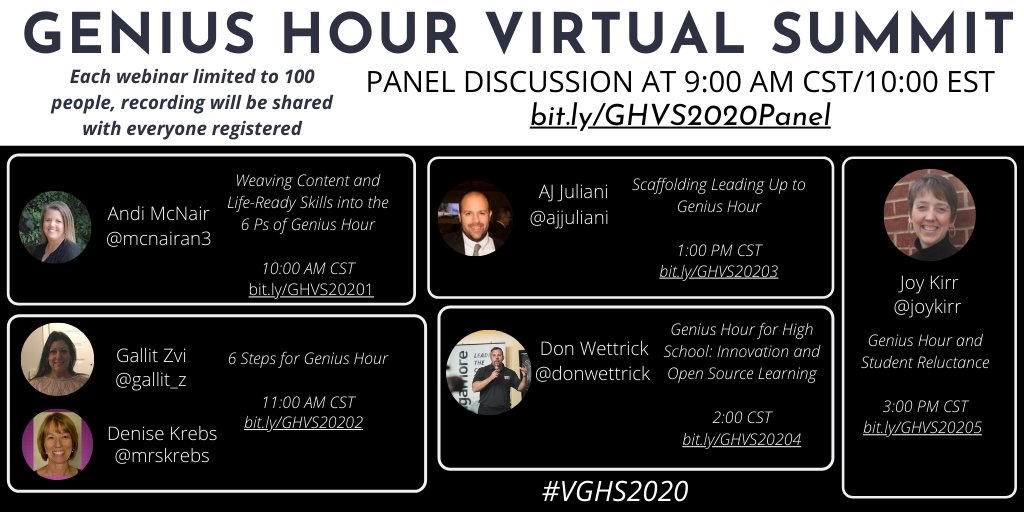
     Participants: Andi McNair, A.J. Juliani, Denise Krebs, Don Wettrick, Gallit Zvi, and Me
     Time: 56:04

Weaving Content and Life-Ready Skills into the Six Ps of Genius Hour
     Host: Andi McNair
     Time: 51:53

Six Steps for Genius Hour
     Hosts: Denise Krebs and Gallit Zvi
     Time: 56:30

Scaffolding Leading Up to Genius Hour
     Host: A.J. Juliani
     Time: 34:29

Genius Hour for High School: Innovation and Open-Source Learning
     Host: Don Wettrick
     Time: 58:30

Tips for Reluctant or Resistant Students
     Host: Me (Joy Kirr)
     Time: 37:54

I JUST noticed today that the hashtag above these words is wrong, and none of us caught it!

Thursday, May 14, 2020

Day 62 - Ramblings

Thursday, May 14, 2020

I woke up thinking about praise and how it affects me. Last night I read about half an hour before heading to bed. Hubby said, "Nice job reading tonight." He meant, "Nice job not being on the computer or phone tonight." I haven't been reading like I thought I would during this time. Like I used to. Like I love to do. When I woke and thought of his praise, I wanted to read. I wonder how the praise we typically provide students during a typical school day affects them. I wonder how the lack of that amount now affects them.

Our advisory activity this week was to interview a friend. We had questions to ask regarding their favorite activities during quarantine and their goals. My good coworker and I shared our answers (to share with the kids), and later I asked some of these questions to another friend. It's a good activity, and I hope the kids get something out of it. The answers shared on FlipGrid so far look promising.

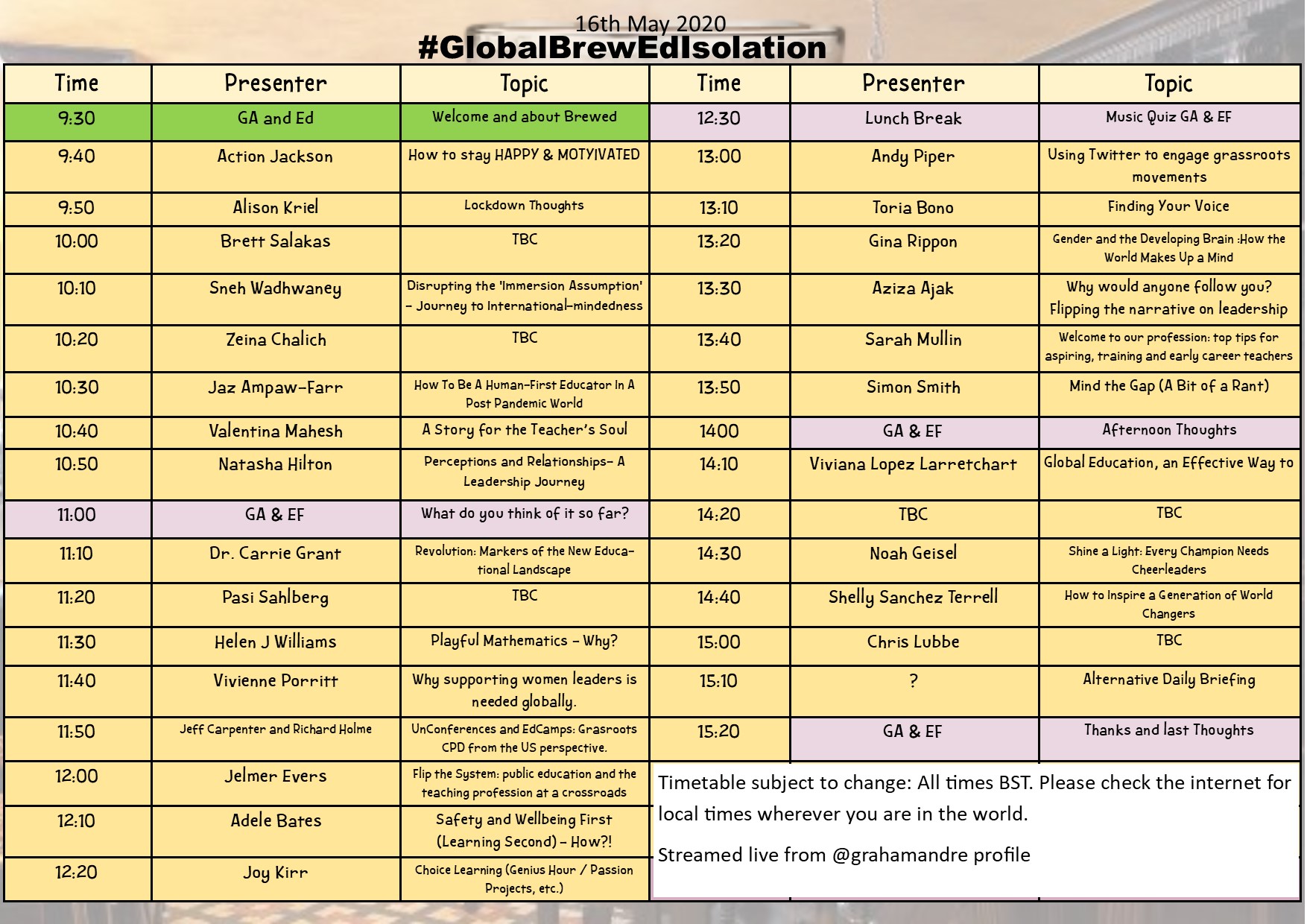
I recorded a ten-minute presentation on genius hour for #GlobalBrewEdIsolation happening all day (in the U.K.) on Saturday. It starts at 3:30 am our time. Ten minute sessions from so many educators ALL DAY!
Image

I don't know how people like @grahamandre pull all this stuff together!

I'm way more than half-way done with my cards for the graduating Seniors.... I'm so excited about it. I'm also excited to get back to card making once I'm done writing postcards to the seventh graders...

Hubby had his first Zoom chat today with an old friend in Detroit. I joined him, because his friend's wife joined him. She even dressed up for us! It was an hour and a half long, from noon - 1:30. Bob took a nap afterwards. He was thankful to me for helping him with the tech, and I'm pretty sure he was very happy with the whole thing, even if he didn't want to do it in the first place.
"It's not the same," he said.
His friend replied, "But it's what we've got." I think that helped him get over the hump.

Wednesday, May 13, 2020

Days 60 & 61

Tuesday and Wednesday, May 12 & 13, 2020

I am so so very fortunate to work where I do. Teachers are loved. We are celebrated. Today I was finally able to get out to one of our Superintendent's invitations for drive-through food. I got pancakes at what the locals call "Mr. A's." I was able to see our former principal and a few other administrators from the district office.
 
And before I knew it... they disappeared!
It's weird, because I had it planned for almost a week, and the morning of, I just felt sick to my stomach for a few minutes, thinking that I was actually going. I have no clue why I felt that way, so when I was in the shower I rationalized my thoughts and my stomach issues left me. I got in the car before I could think about it again. And it was all FINE. I don't know why I was anxious about it. It made me wonder - if someone who's pretty "with it" right now and has a pretty solid head on her shoulder has these moments of anxiety, what about those kids whose normal response is anxiety??

After checking and responding to work emails, a different part of my day started online at 9am with the #GHVS2020 - the Genius Hour Virtual Summit that Andi McNair put together on the fly last week. We were a panel of passionate educators who had all written (and got published!) about genius hour. The panel was SO fulfilling to me. I felt like I was with my tribe once again. I felt needed. I felt valued. We held it via a Zoom webinar, so there were 100 people with us, and the other 300 or so who registered would get the recordings.

Here is my session:
     Genius Hour: Student Reluctance or Resistance

I'll upload the others here when I get them. :)

We also had a staff meeting Tuesday - those are always interesting... I then had my evaluation, and it was very nice. I kind of felt that I was in his office... ? 

Today I was so motivated to work on my own genius hour project for the Seniors. I cranked out a lot more cards, and I did a ton of little things that will help the project progress (see my other blog soon for that update). Checking in on my own students' progress on their projects was a blast, as well, today.

What's been with me the last two days is a feeling of value. Sharing about my passion once again (it's been awhile!) gave me a boost I didn't know I was missing. I haven't presented in a long while, and even though I was basically talking to my computer for my session, I was able to share things I hadn't shared in quite awhile. It brought that need back for me - to share my passions. I don't know how this will translate, but I've got the bug again.

Monday, May 11, 2020

Genius Hour Virtual Summit (Day 59)

... is tomorrow (Tuesday, May 12, 2020)!

I do not have a script. I have ideas I'd love to share, and I'd love to learn from YOU! Join when you can if you're interested in learning more about Genius Hour / Passion Projects / 20% Time / Inquiry

bit.ly/GHVS2020Panel <-- 9am CST with everyone listed below bit.ly/GHVS20201 <-- 10am CST with Andi McNair bit.ly/GHVS20202 <-- 11am CST with Gallit Zvi & Denise Krebs bit.ly/GHVS20203 <-- 1pm CST with A.J. Juliani bit.ly/GHVS20204 <-- 2pm CST with Don Wettrick bit.ly/GHVS20205 <-- 3pm CST with me

Image

Instead of writing a blog post today, I'll be lining up the resources I'd love to share tomorrow.

If you have registered and do not make it into the Zoom call (limit is 100), Andi McNair will send you the recording. 👍

And here's the gang, getting ready for tomorrow - it was so fun to chat with them once again!
Gallit, Don, AJ, Andi, and Denise (GHO, so I'm not pictured)

Wednesday, April 29, 2020

Day 47 - Under 60%

I now provide lessons on Wednesdays and Fridays in this seventh week of quarantine.

For the last two Fridays, the days where we have three choices for our article of the week and no comprehension questions, I've gotten proof of 90% and 85% student participation.

For the last two Wednesdays, the days I think are the most intriguing lessons, the days with the video attached of me and Mrs. Field and Mr. Stott talking to students, I've gotten proof of 54% and 57% student participation.

Last Wednesday and this Wednesday and future Wednesdays will be focused on Genius Hour / Passion Projects / Independent Inquiry. THIS is where my passion lies. THIS is where I think the students will benefit the most. THIS is where we (students and teachers alike) will be challenged, have to adapt, and will feel failures and successes. I am having a difficult time seeing less than 60% engagement. I'll check today, tomorrow, Friday, Saturday, Sunday, Monday and Tuesday into next week to see who shared somehow that they thought of the work of brainstorming for their project today. I'll keep looking and keep providing feedback on their document.

It's not that I want them to want to do the work - it used to be that way, I suppose. I have tried to make the work relevant to what they'll need in the future, and I've tried to share with them our reasons for the work... I used to get more engagement than I'm getting now, obviously. What I realized today is that I want them to want to be in our class.

And maybe they do.

Tuesday, April 28, 2020

Day 46 - Kick in the Pants

Tuesday, April 28, 2020

I had a rhythm going today.

I woke up early, got ready early, was ready for our staff meeting, went out on the front porch rocking chair for the meeting (and was able to see the dew disappear, and two threads of silk from a spider), heard the goldfinches, made a couple more cards for the seniors.......

It's this - this new project - that was my kick in the pants. We're in week seven of this quarantine. It's time for me to get my act together. I was all ready to go the first two weeks, and then motivation ran dry quickly. All the changes in how we were supposed to teach really boggled my mind and hit my body something fierce.

Then we began talking about genius hour. My coworkers were on board, and we were excited about it. I created my heartbreak map, and I brainstormed what I could do for others, what I could do for myself,  what I would like to learn, what I would like to improve, and what I would do "if I had the time." I figured out my project. And I've already begun. I'm making cards for each Senior I had in ELA class or in homeroom.

I got to counting and cutting the paper. Folding. Deciding on the design. Getting started with five prototypes. Copying the "2020" for the front on the window pane...

I did a whole bunch yesterday, finalizing my idea. I felt like I had a purpose again. To really put me over the edge, a former student (now a Senior), sent me a graduation invite (only happening virtually) and a personal letter. I wanted to cry, and then I wanted to smile. I smiled and read it aloud to Bob. I called my mom and read it to her. I now feel like I have more of a purpose.

Today I did more of the non-thinking work (cutting, folding, tracing).
I am excited about my project.
I'm excited about it because it's what really fits me.

Brainstorming for Genius Hour is the toughest part for many children. It's always been tough for me, too. I have more to learn about brainstorming. I seem to pick projects that don't last two weeks. Not this time. This feels right. Although it will take some time, I can do it.

Of course I'll be documenting the process on my blog for my projects...

Monday, April 13, 2020

Genius Hour Shifts to Online

Thank you to online colleague and face-to-face friend Aric Foster for the push to write this post...

Aric asked me for three bullet points and tips for shifting Genius Hour (or whatever you'd like to call it) online... Here are the basics I sent to him...

1) What about heartbreak maps?? They would be perfect for this situation. That could be the start of "What's a problem in your world you want to help solve?" Right now, our students want change for themselves and for others. Two great questions to get them thinking (ask one at a time) - What is something YOU want to improve for yourself? What is something someone you know needs? What is something you think the world needs?  TIP for the brainstorming part of the process: GIVE THEM TIME. I used to jump in and have students' ideas due in one week (or so). But when I tried to do it myself, it was often difficult for ME to come up with an idea worthy of my time. If the ideas we push out of them too soon aren't something they're passionate about, it's going to flop. It's got to be something they really really want to do. So provide the time for the idea to come. Once ideas start coming in, have students share them with others. That way those without ideas (yet) can use those as inspiration (even if they do the same thing - who the heck cares, as long as they're doing something for themselves or others?!).

2) While students (and YOU! - TIP: You should be doing your OWN, so you can be a step ahead of the kids in everything you're asking them to do.) are coming up with a topic/issue, you can be figuring out a couple of logistics.

3) You'll also want to come up with some sort of process/system for them to follow.  TIP for the process: Make something visible, so students can see where their peers are and ask each other for help with a step (if needed).

Then... go from there... keep doing your own project and follow along with student projects, going with the flow. One more TIP: Since you won't be in the classroom, roaming from student to student to see how they're doing, have some sort of reflection or exit slip for students to complete at the end of the day or week... Something that shows what their plan is for the week, how it went for them, and what their next plans are for the next week would be helpful to you and them.

And remember... You are a genius, and the world needs your contribution! (Thanks, Angela Maiers!)

Looking for MORE? Check out... 


Monday, June 17, 2019

What has contributed to the educator you are today?

What has contributed to the educator you are today?
This is this week's question in the "8 Weeks of Summer" blog challenge.

I was actually thinking of this very thing yesterday morning. We (Hubby and I) were headed to Milwaukee for #USMSpark (Hubby golfs there), and the venue and people are familiar to me. I'd be seeing a few new faces, and I was really looking forward to it. I've been fortunate to be a "featured speaker" in the past, and this year I've only got one presentation, so I could relax and enjoy learning more from others instead of talking. Our keynote speaker Monday morning was Angela Maiers. If you don't yet know her, she's all about helping children do what they WANT to do - what matters to them. Knowing I'd learn from her once again, it took me back to when things started really changing in my teaching life.

In the fall of 2011, I was the one chosen to "volunteer" to pilot curriculum with iPads (I'd never even touched one!), and four weeks later, I'd learned a TON. (I believe I wrote about this story in Shift This.) In February of that same school year, someone in my district thought it would be good if I attended a workshop in Michigan where we worked on a problem - "What's a problem in your school?" was the question Ewan McIntosh asked us, and then he gave us the rest of the day to work on this problem. This jaunt got me started on what was to be called "genius hour," although at that time it was "independent reading" - IN class (wha?! - that wasn't even considered in our school in 2012)!

That summer of 2012, leaders in my district sent me to Boston to attend the Building Learning Communities conference put out by Alan November. It was there that I first heard Angela Maiers. She put me out of my comfort zone not five minutes into her presentation when we had to introduce ourselves to the person next to us and state what our "genius" was. What was my genius? I'd never thought of this before, as I'd never been asked. I remember sitting next to JoAnn Jacobs (she'd come all the way from Hawaii!), and she seemed much more confident than I was. I went with "optimistic," as when I wake to see a new day, I see new starts, new chances, and new opportunities to do what's right. The rest of that hour was invigorating and inspiring. (Today's hour was about how teachers need to know that WE matter, too.)

In fact, that entire school year was transformative. Granted, it was my 16th or so year teaching, but it was only my third year with a classroom. Since then, I've been asking, "What's a problem, and what are you going to do about it?" Since then, I've gotten connected to thousands of educators on Twitter. Since then, I've blogged to reflect on my learning. Since then, I've read so many professional books to help with my teaching. Since then, I've been attending and presenting at many conferences - using some of my district's money, and some of my own and on my own time. Since then, I've been offering as much choice as I can (within the parameters I have) to students. Since then, I've been conferring 1:1 with students every day, and THAT has made all the difference.

Tag - you're it. What has contributed to the educator you are today?

By the way, YOU are a genius... and the world NEEDS your contribution! ~Angela Maiers


This post is week 2 of 8 in the 8 Weeks of Summer Blog Challenge for educators. Check out #8weeksofsummer for more inspiration for YOU to write... #nudgenudge

Friday, January 4, 2019

More Nonfiction

I decided last night, as I was soaking up Jack Andraka's Breakthrough, that I need to read and share more nonfiction with my students this year. I also finished Mountains Beyond Mountains by Tracy Kidder this week. I posted it on instagram, and one of my former students said she read it for a class her senior year. That one makes me simply want to do MORE to become a better person.

With Jack's book (I'm going to finish in two days), it's personal.

A dear friend of my husband was diagnosed (early, she says) in June with pancreatic cancer. A dear friend of my own's father passed from this terrible disease. I didn't really know about this type of cancer until June last year, and now I fear for our friend.

I've heard of Jack Andraka, and knew he did something remarkable with science, and I'd probably even heard it was for early detection of pancreatic cancer, but at that point, I simply didn't care enough to read it. It wasn't personal for me.

His writing is personal. Jack's close family friend he called an uncle passed away from pancreatic cancer. His work is personal. He spent months of his freshman year working towards this ONE thing. My reading became personal as soon as I stepped into this book. It wasn't simply "something on my to-read list" anymore.

There's so much more to say about this book (that I now need to purchase for the classroom), but I'm not here to write about the book. I'm here to explore - again - that this is how I'd love for school to be. I'm in the perfect position - ELA class - where we can read and write like crazy. I truly wish we could make it more personal for students - reading and writing MOST days about what we believe is important.

Some of my seventh graders need more guidance, I know. Some of them seem apathetic about so many issues; I get it. As I provide short video feedback on our last bit of teacher-directed writing however, I am catching some students who have the skills and asking them to move FORWARD. To not take my direction, but use the same skills to write about what THEY deem important. Great - you can tell me who the dynamic character is in your book and back it up with evidence and then explain it all clearly? Then NEXT time, write about a PERSON you know that is dynamic, and provide the evidence and explain. Better yet - write about something you want DONE - find your audience - and write to THEM about what you think needs to be done, and then share your evidence and your WHY. Make it personal. Do it because it's right and good for you and your life, or the lives of others.

What other nonfiction books are out there for our younger adolescent students? I need more nonfiction books that will get my middle schoolers (some of whom still think reading is not for them) feeling, thinking, and responding. Responding through writing, projects, actions... More along what I wanted our genius hour to be. More along the lines of Erin Olson's idea of - "Read. Be inspired. Do something inspiring."

Please add your favorites in the comments below - and tag another reader with this post so I may easily curate a bunch and pay for them when I can. Please share how you use nonfiction - and make it personal - for our students. Thank you!

Saturday, July 28, 2018

Ambiguity as a Learning Tool

The Building Learning Communities conference in Boston always inspires and challenges me.

Even though this was my fourth consecutive year presenting sessions, I was also asked to present one of the keynotes. Wednesday and Friday are reserved for one-hour keynotes, and Thursday is for three-four 15-20 minute keynotes. Thank goodness I was asked to present on Thursday!

I'd known about this presentation since November. Ideas percolated around my brain for months before I started putting ideas down on paper. I had not been told what to speak on, and the closer it got to July, the more I got to thinking I was on my own to decide.

This ambiguity was so difficult for me. Sure, I could set my own sessions for the week - those were based on where I felt my strengths lie, and I had many resources to share for when participants had questions. The 20 minutes in front of 500 people?? It was like choosing the right song for "American Idol"! (mine would be "Broken Wing" from Martina McBride!)

As I wrestled with what the message should be, and who my audience was, I never thought that not knowing - this ambiguity - this uncertainty - was what was so difficult for me.

That is, until the day AFTER my keynote, Ted Dintersmith - author of What School Could Be - said that ambiguity scares students. Taking a path where they might fail is scary. He says that we have many "Go fetch a dog biscuit" kids. They are really good at following our directions. They are not good with ambiguity.


I immediately thought - that's why the keynote was so difficult for me! If Alan November had told me what he wanted, I would do it. If nobody cared for the idea, I could blame it on someone else...

I figured it out. I had to! I did have parameters - It had to be ready by July 26th at 8:30 am, and it could be 15-20 minutes long. I also felt I had to share something about shifting... shifting SOMEthing. I didn't want to talk about Shift This (which of course, you can purchase right here 😉).

I also knew I didn't want to use the ideas from my "Shift the Culture" one-hour presentation. I had to create something new.

With these parameters, I thought about the history of my learning at BLC, what I've learned from others, and I decided it should be about shifting the language.
(Yes, deaf education is part of my journey.)

I was geeked to say hello (again) to the other two keynoters - both passionate educators on the other ends of the spectrum - Aaron Polansky from a vocational school in Massachusetts, and Pana Asavavatana who works with K-2 in Taiwan! When I got to BLC on Wednesday, Aaron said he'd changed his message a few times already, and he even changed it further the night prior! I think he had a tough time with the ambiguity, as well. I think Pana had her message about literacy ready to go (I could be totally wrong about that - we didn't have much time to talk) - even though we all had nerves galore!

I became more comfortable with the message in it as I went through sessions on Wednesday, the day prior to the most nerve-wracking thing I've had to do in a long time. Others at BLC were talking about change, and shifts they're trying to make, and how "others at my school" weren't on the same page.

The morning of the presentation, we were told our order (what a relief when I found out I'd go first!), and Alan said, "Your topic is genius hour, right?" My eyebrows went up and I froze for a moment. 

I said, "Nope. It's on shifting the language. Labels we're given and such."

He only said, "Interesting!" and went on explaining more plans for the next hour... Phew!

The ambiguity I was offered was a gift in disguise. I learned so much from brainstorming, trying different ideas, considering past conference messages, putting together much of what I've learned, and listening to the audience / participants the day prior. I tweaked two or three things based on what I'd learned Wednesday, and I was as ready as I'd ever be Thursday morning.

How did it go?

I'm happy with what I did. I have no idea what I actually said... I had my notes, but don't remember  using them. I did hear laughter in all the right places, and I saw many heads nod. Reactions and expressions of gratefulness from educators the rest of the day solidified that I had reached them in some way. They felt included. They felt as if I knew them. They felt empowered. Alan told me I'd done a "fabulous" job, and a few told me they had tears (which I didn't expect).

My lessons learned?

-Go with your gut. Say what you feel you need to say. Speak from the heart.
-Use the ambiguity as a learning experience. Research, reflect, brainstorm, tweak, get feedback...
-Provide students more chances every day to struggle with - and learn from - such vagueness.
-When they struggle with uncertainty, help them to notice all they are learning.
-Provide tools for them to persevere, so it will be easier for them the next time around.
-As always, these challenges should come without any grade attached...
-Um... hello - doesn't this sound a bit like Genius Hour? Or personalizing learning - ALL DAY?!

Challenge for all of us - How can we incorporate more opportunities for our children / students to struggle with ambiguity during our school days?

A HUGE thank you to Alan November and the BLC team for providing me this experience. More huge kudos to Aaron and Pana - we did it!! Everyone loved your messages! Let's put a handle on helping students and educators make more connections! I'm excited to read about your own reflections.

Here's the "moment" I made using Twitter - to capture some of the essence of my message. Stay tuned for further posts as a result of reflections from this fabulous conference!

Sunday, May 20, 2018

Polar Bears or People

My only niece and nephew turned the age of twelve earlier this month. Bob and I gave them cold hard cash - literally! We froze $50 in a baggie in water in sour cream containers. In order to find out what and where their gift was, they had to solve a riddle. Such is how we give gifts in our family if the receiver has everything he or she already needs...

My nephew Robert pocketed the money right away, and my niece Rosann announced, "I'm giving my money to the polar bears!"

Silence.

After a time, I was able to ask Rosann, "Where will your money go? What will the organization do with your money for the polar bears?" She mentioned something about them relocating bears that had gotten too far away.

I tried to be a good actress and be happy for her - proud of her. I don't know if I was convincing.

The thing is, she's a giving person. She also sees that for my birthday we put together what some call "blessings bags" - see the post on how to make your own here. I donated money to St. Jude's in her name for her first communion. She volunteers with the Girl Scouts at Feed My Starving Children. What was my problem?! Why did her saying she'd give her money to the polar bears put me off? Why did I think - Maybe her parents will talk her out of giving ALL of her money to the polar bears. (It had totaled $140 by then.) Don't PEOPLE count more?

I saw my problem this morning (while washing dishes).

I was being a hypocrite.

EVERY time I speak or write about Genius Hour, 20% Time, Passion Projects, Personalized Learning... I have in the forefront of my mind that it is about the KIDS. It's about what THEY deem important. Who am I to judge? What if the biggest group of people helping polar bears financially are children? I revisited my post on the value of frozen marbles today. I'll promise to keep my hypocrisy at bay, and yet keep asking questions that keep the conversations going.
Pixabay

Sunday, March 25, 2018

Teach Me Your Talent

HOW TO:
     "Teach Me Your Talent" is one way for students to share what they love with other students. It can be a way to introduce genius hour-type learning, bring students' passions IN to the classroom, or just something fun to do so your students can learn more about each other!

     We started by introducing the idea to students the week of PARCC (standardized) testing. They had that entire week to brainstorm ideas and get feedback from peers. The next Monday, they needed to declare what they would present. Starting that Monday, we had four days of mini lessons and time to practice - presentation skills, such as volume, intonation, eye contact, gestures, poise... all thanks to Erik Palmer's Well Spoken book. We used videos, teacher models, and students signed up to do 15 second to 1 minute stints to practice their speaking skills, as well. These four days were also used for students to plan their own presentations. We used this sheet to guide us. (It was during this time that I met 1:1 with students regarding their learning for the quarter. We came up with the final grade and their comments for the report card.)

Skills/Talents/Hobbies shared this year:

Observations I want to remember...
    Teachers presented one this year as a model - turned out to be helpful!
    Parents came in to provide feedback while I was in the corner conferring with students 1:1.
    When a student presenting said, "cut off the bottom of the paper" and another rudely responded, "seems like a big waste of paper," the student presenting countered with, "I'm sure you can find something to do with that extra slip of paper. A bookmark, perhaps." What class.
    Thanks to the observation of our co-teacher, when we only had three people presenting, we still created four groups - one just hung out for 4 minutes together in the rotation. When in that "station," these students took on the responsibility of timer and announcer when there was one minute left.
    Hearing a student say, "I haven't done this is so long."
    Hearing a parent say, "I feel like I'm in 7th grade again."
    Messes were cleaned up by students.
    Even when a presentation didn't go all too well, at least one student in the group would thank the presenter, and then the others usually added their own thanks.
    One student kept saying "I failed." (No grades - just in his mind.) I was able to reiterate at his parent/teacher conference that he kept getting better and better during the four rotations. By the time the fourth one came about, he had succeeded! Hopefully after our talk, he is learning that practicing before would make him more successful.
    When I would forget, students would take care of the timer (student responsibility next year).
    Parents came in, went through rotations, and even gave feedback!


I gave students a quick form to ask them for their feedback. What always gets me is the way some comments contradict others ("very easy" / "stressful" or "more time" / "make it shorter"). Here are the ideas they had:

What went well? (Student Views)
  It was fun to play with other's stuff.
  Everyone listened to everyone.
  The people I taught seemed to be interested in what I taught.
  Everyone was paying attention and we got through everyone.
  The speaking part went well.
  The whole idea was cool.
  I definitely learned new things.
  I learned about my classmates and had fun.
  It was fun.
  There were some really good things that people demonstrated.
  Everyone tried new things.
  Most of us had interesting things to show.
  I think the organization went well.
  Everyone brought in their projects on time.
  People had good performances.
  People tried.
  Creativity.
  The "balanced" out groups.
  Most people learned something new and I liked when talents went over 3:30 min - we learned more.
  I liked how I could share what my classmates like to do, and I can share what I like to do.
  I learned many things about different sports.
  Learning new things, and new things about other people.
  Most people seemed prepared and seemed to be having fun.
  Everyone can learn about different things.
  It was very easy.
  We had enough time.
  Everybody was able to do the task taught.
  The time we had to prepare for it.
  Nobody cut off person talking.
  Fun trying the person's talent.

Suggestions for Students FROM Students:
  Don't overdo it.
  Listen.
  Cover main ideas and explain them.
  Speak clearer and louder.
  Pay attention to who's talking.
  Be more prepared / practice.
  Explain the talent better.
  Don't do things if it takes really long.
  Pick something that is actually a talent.
  Longer presentations are better.
  Teach for the whole three minutes.
  Take it more seriously.
  Put more time into planning.
  Try to at least seem interested in what you're doing.
  Find something really unique and useful.
  Don't have side conversations - it distracts the speaker.
  Think of outrageous ideas.

Suggestions for the Teacher from Students:
  Bigger groups. (This year we had both, depending on the day, and they liked the smaller groups.)
  Extend time for talent.
  Make it a little bit shorter.
  Don't grade this activity. (I didn't.)
  Not in groups - entire class presentations.
  Maybe a little more time for preparing and getting ready.
  We didn't need so much time to plan.
  It was pretty boring and stressful.
  Let students pick groups.
  Decide groups ahead of time.
  Don't take pictures.
  More organized way of presenting.
  Bigger spaces for each group.
  Let students go to stations you want to.
  Show all groups to the class.
  Have groups of different times - for instance, if some plan for 5 min., have them all go at the same time. (Students wanted slime to be all on the same day. I cannot stand slime, and always hope no one decides to make slime...This year we had three in one class - all different types of slime, all on different days. Maybe one shot would be better!)

My Sad Note:
   I've got some students who don't like ELA (say it isn't so!) and/or struggle with reading and writing. One reason I love this project is that many of those students shine during these presentations. I will say that this year I did have some of those. I also had four students this year who ... blew it off. I am reminded once again that school is not a priority in their lives. I'm just sad that even this activity couldn't encourage them to bring their passions in to our classroom. I will continue to implement this activity, however, because of all the success and/or learning most students have.

Want to see it in action?
   Check out @KirrClass tweets! You can also find much of our learning on Instagram.

Here's our video from 2017...
   I loved looking at it, as we set up the room differently this past year based on feedback from last year, and I don't know which way is better! Next year, the students can decide once again. :)


*UPDATE from 2019...

Notes from 2019:
     We didn't do as many lessons for presenting, as they're presenting to such small groups.
     We need to have more check points - a day to bring materials to class, especially.
     Next year, we'd like to do this EARLIER in the year - so students become more familiar with each other and so there aren't so many saying, "I don't have any talents or skills."
     Next year, we'd like to scaffold at least TWO presentations. The first could be students teaching something they know or enjoy, via a slideshow. THEN they can become interactive presentations.
     Note for myself - do NOT try to squeeze this into two days (like I had to for one class due to a surprise meeting at district office), as then I won't have time to confer with students about their final grade for the quarter, and we won't have any time for independent reading.

Wednesday, May 10, 2017

Shift This!

Here's the inside story...

A large publisher of educational books contacted me in 2015, asking me to write an outline for them for a book about Genius Hour. Hmmm... That had been done - a few times by then, and even more by now. The list is growing, and I keep it on the LiveBinder here.

So I wrote an outline about what trying Genius Hour did for my classroom... and they said that wasn't what they were looking for. I was told I could write a blog post for their website. Harumph.

I had shared the first part of the story with my students, so I had to update them on this disappointment. They threw my words back at me... "If it's something you want to do, you should do it anyway." They had a point. So I kept going. Why not?! [Fancy this - Bob (Hubby/soul mate) - had told me earlier... "It's only a matter of time."]

In August of 2016, I had a revelation of sorts, and I was almost finished with this book about shifts I'd made since implementing Genius Hour. It felt like a huge blog post about how I've changed so many parts of our classroom as a result of handing over one hour a week to my students. I thought of Dave & Shelley Burgess... And I thought, "The worst they can say is 'No.'"

And now it's here. After months of going through the editing process (such great lessons for me that I was able to share with my students!!), and multiple nights wondering, "Is it good enough?"... it has arrived on Amazon.

Here is a glimpse inside the book - through the lens of the website.
If you're reading the book, please connect with me through a blog post or your thoughts in an email. I'd love to add your ideas to the website, so others can learn from YOU! Let's keep the conversation going so we can shift learning back to our students!

Addition 5/13/17: Here's Dave Burgess's rendition of why you should read Shift This!

Tuesday, April 18, 2017

Saying "Yes"

I almost said No.

When Caren Kimbarovsky contacted me about being on a panel to talk about "personalized learning" at the local NICE meeting, I immediately thought - I have so much to do that weekend, and I've already committed to so many things in April. Then came another thought - I don't have school the next day... and I've never been on a panel before.

So I said Yes.

And I LOVED it.

As a connected educator, you get asked to do many things that are not in your normal job description. For the month of April, I was asked to speak at a mini-conference in the AM before an edcamp in the PM, review a book before it comes out, moderate two chats, attend a half-day edcamp, and be on this panel. I said YES to all but one. I'm so glad I was able to be a part of this panel. Check out the participants:
We were given free dinner (Chipotle and cookies!), and a few of us chatted prior to the start of the discussion. My goal was to listen more than I spoke, and that was very easy, as I was in the presence of educators that have done way more than I ever had. I was so eager to learn from them!

I had to share my take-aways (and reminders)...
  • Jon Bergmann shared that the "one thing every teacher can do tomorrow" is something I'm already doing! Video/audio feedback with screencasts for their students! When he started describing this, I practically jumped out of my chair. I'm on the right track!
  • A participant in the audience shared that his students reflect back in the same manner. I know one of my next steps now!
  • We were all reminded, once again, that the tech does not matter - RELATIONSHIPS matter. No idea is right for EVERY student. Some students will still not do the work. TALK with students. Do not let the idea that not every student will work stop you from trying new things in class.
  • "Relevance" is the word I kept thinking of for these two hours. If we continue to make learning relevant to our students, more will step up to the plate to practice and learn the skills.
  • We need to have a common language - and we need to SHARE this with parents and students, so they, too, may advocate for change in education.
  • I am not overwhelmed with "too many things to do." Teachers on this panel seem to be doing even more work than I am - all for the sake of personalizing the learning.

Coming home with the windows down and the radio cranked up, I knew I will continue to say YES to many of these opportunities, as they continue to reinvigorate me. I may not do everything in my class that I'd like to try, but I'm surrounded by others who inspire me to keep on keepin' on!

Saturday, February 4, 2017

Challenge Your Own Ideas

I just finished reading The Radioactive Boy Scout: The Frightening true story of a whiz kid and his homemade nuclear reactor, by Ken Silverstein, from 2004.

David Hahn lived in Commerce Township, MI (a suburb of Detroit), and loved science. He wanted to collect each element on the periodic table. He wanted to... well, you can tell by the title of the story. Feel free to read it for details, but this is not a book review.

This is what caught my eye, from my teaching viewpoint:
If he'd been interested, David would have found it a simple matter to learn about the cons as well as the pros of the atomic age. But as with newfound converts to any cause, David wanted his ideas reinforced, not challenged. Certainly, the Curies and some of the other nuclear pioneers had suffered as a result of their labors, but that hadn't kept them out of the laboratory. For David, as for his heroes, the thrill of discovery made worthwhile any risks. (p 56)
Myriad stories of nuclear disasters and failed breeder reactors later...
Hence, despite coming of age at a time in which all the assorted screwups and accidents of the atomic age had generated a powerful antinuclear movement, David remained comfortably cocooned within the confident optimism of the 1950s and 1960s. His passion for the atom was fueled by the conservative family and community environment in which he was raised, as well as a natural aversion to intellectual challenge (which does not bode well for a career in science). "I tried not to read anything that would disappoint me or make me negative," he said candidly of his research strategy. "If I knew it had a critical perspective, I wouldn't even pick it up." (p 133)
YES. I remember when I first started learning about Genius Hour, I would NOT look at any blog posts or articles that went against what I wanted to hear. After awhile, however, words written against this type of learning really stuck in my head. I started to leave comments on their blog posts, sharing my thoughts. I really didn't want to see what they wrote back, but gradually I became interested more in the conversation than the one-sided "echo chamber" that I had fallen into. I created a new tab on the LiveBinder for opposing views.

My seventh graders experienced something similar this week. No matter how much we stress that we discuss ideas so that we may LEARN from others, I have a few who believe in one way or the other and will NOT budge during a fishbowl discussion... yet. They do NOT want to hear the other side... yet. They say they are listening, and yet they keep going back to what they'd already said before, or they share more of their own ideas, not even taking time to acknowledge that someone else spoke. They wanted to continue the discussion in the next period because, "I just have one more thing I need to say."

My last class, however, came to find peace in their fishbowl discussion on Friday. They admitted that there are different perspectives, from different times in the story. I happened to catch it on camera.
After this was said, their discussion petered out, and they agreed to disagree, without any animosity afterwards. They're learning to accept different opinions - so difficult at this age. I have a plan to help my other two classes see different perspectives the next time we conduct a fishbowl discussion... I'll let you know how it goes in a future post!

As teachers, we NEED to research. It's our duty to seek the opposition. Seek out other educators who have tried what we want to try in the classroom. Read or hear their stories of triumph, and of failure. Read about successes they celebrated and pitfalls they endured.

I believe it's also our duty to share what we're trying, so we can INVITE opposition. I share with parents every two weeks (our class updates are here). When parents express that they are not happy about something I'm doing (or not doing) in the classroom and my ideas are challenged, I become more reflective. I see through another lens and question the ideas once again. I conduct more research. I ask more questions. When educators challenge my ideas on Twitter or on this blog, I can now see it as an opportunity to GROW.

Here's my challenge for you: Start a blog if you haven't already. Write about what's important to you. Share your ideas. Watch your reflection become more useful, and watch your ideas develop and change. Do not become like David Hahn - in jeopardy of hurting yourself or those around you. Share, and seek responses - positive or negative.

Ready to start your blog? Here are seven tools compared by Richard Byrne!